
Setting Target Numbers by Pressure
A quick cheat sheet for fiction-first play

Most TN charts try to measure difficulty.
They ask:
How hard is this action?
That’s not the question I care about at the table.
What I really want to know is:
How hard is the world pushing back right now?
That’s pressure.
Once you know the pressure, the target number is easy.
Pressure Anchors
Pick the pressure. The number follows.
Use the column that matches the dice your system uses.
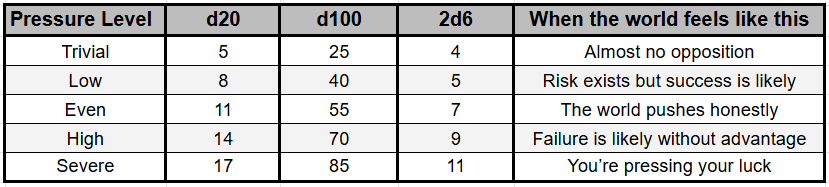
If it’s impossible, don’t roll.
If there’s no pressure, don’t roll.
Everything else lives somewhere on this chart.
Download the Table
A one-page printable version of the Pressure Anchors table.

Three Quick Examples
Picking a lock in an empty hallway
No guards. No clock. No consequences for retrying.
No pressure. No roll.
You get it open.Climbing a wet garden wall at night
It’s slick, and a bad step could send you back to the ground.
Low pressure.Leaping from a burning balcony to a moving carriage
Flames behind you. Wheels below.
High pressure.
How Swashbuckler! Uses This
In Swashbuckler!, I compress this whole table down to three bands:
Low
Even
High
That’s where most rolls live anyway, and the tighter range keeps play fast and cinematic.
Feel the Heat
This isn’t a difficulty system.
It’s a judgment aid.
You’re not measuring physics.
You’re reading the situation.
Pick the pressure.
Let the number follow.
Embrace the Chaos.
Want in? Just hit the button.
Subscribe for Free or toss a coin to your chaotic uncle—either way, you get the goods.
Rules are optional. This part isn’t.